What a butterfly can teach us about death, transformation, and the promise of heaven.

On November 2, the Feast of All Souls, I found myself at school mass listening to a homily that was intended to help the children understand the beauty of the Hallowtide Triduum. Yet, as I sat in the pew, I found myself reflecting on a child whose transformation I will never forget.
As I looked at my two oldest sons sitting with their classmates, one dressed as a saint as part of his sacramental year of preparation, and my youngest sitting beside me, not yet school age, I couldn’t help but remember the little baby who once grew and grew inside my own motherly body. My womb, which was both a place of life and, ultimately, a tomb, held my son until the day we delivered him into eternity. I often think about that sacred transition: how the little boy whose body carried genetic deficits, a malformed heart and brain, skeletal deformities, clubbed feet, and scoliosis was no longer defined by any of those things. I imagine him transformed, no longer sluggish and limited by his physical body in utero, but a magnificent and beautiful soul, like a butterfly taking flight.
It was this image that made Fr. Larry Searles’ homily on All Souls’ Day particularly moving. With the permission of Fr. Larry, I am sharing his reflection, which uses something as ordinary as a caterpillar to help us understand something as extraordinary as the promise of eternal life.
The Transformation of a Butterfly
Fr. Larry began by describing the remarkable transformation that takes place when a caterpillar becomes a butterfly. When a caterpillar reaches maturity, it finds a safe branch or stem, attaches itself with a small silk pad, and hangs upside down in the shape of a J. It sheds its outer skin one final time, revealing a soft shell called a chrysalis, which soon hardens.
Inside the chrysalis, something extraordinary happens. Much of the caterpillar’s body breaks down into a protein-rich substance, while special cells survive and begin building entirely new structures: wings, antennae, legs, and the other features of an adult butterfly.
After approximately one to two weeks, the chrysalis becomes transparent, and the butterfly emerges. Its wings are initially soft, wet, and crumpled. The butterfly hangs upside down, pumping fluid into its wings until they expand, dry, and strengthen. Finally, it takes flight.
Fr. Larry explained why God might have left such an extraordinary process in nature:
“God has left in nature this process of transformation so we can better understand what has happened to those who have died.”
A Message from the Butterfly
Fr. Larry invited the children to imagine what it might be like if they were caterpillars.
Imagine that you had a caterpillar friend who one day disappeared into a chrysalis. You never saw that friend again. But then, one day, a beautiful butterfly came and landed on a branch beside you.
What if that butterfly was your friend, transformed?
Fr. Larry imagined what the butterfly might say:
“I have been transformed into a butterfly by our heavenly Father.
I no longer have to climb trees, because I can now fly over the whole wood and beyond.I no longer eat leaves, but rather I delight in the nectar that oozes from the most beautiful flowers.
I no longer fear birds, because the markings on my wings scare birds away because they think I am a hawk trying to eat them!
You too will become like me, but for now I send you to the needy caterpillars.
Tell them about me, and let them know that they, too, will one day soar on wings over all the earth, and dine on nectar with no fear of being eaten by birds.”
What a beautiful image of the promise of heaven! Fr. Larry brought the analogy back to our own lives:
“We are not caterpillars, but this is our story. Just like the caterpillars could never imagine the life that awaits them as butterflies, nor can we imagine the life that Jesus has given us by his death and resurrection.”
How often do we try to imagine heaven through the limitations of our earthly lives? We understand what it means to walk, to work, to struggle, to experience illness, and to carry the burdens of our physical bodies. But how could we possibly comprehend the fullness of the life that awaits us? Our earthly existence is not the end of our story.
The Tomb Could Not Hold Him
The butterfly’s transformation offers a glimpse into the hope of our own resurrection, but Fr. Larry brought the children back to the most important part of our faith: Jesus Christ.
He continued:
“Jesus’ silk pocket was the tomb, but Jesus’ tomb could not hold him. Jesus is alive. He has resurrected. He announces to us that we will all be transformed, not from caterpillars to butterflies, but from weak and sometimes frightened people, into beings outshining the glory of the angels. That is the promise God makes to each and everyone of you today.”
The resurrection is the foundation of our hope. Christ has conquered death, and through Him, we are promised eternal life.
This is the beautiful connection between the celebrations of All Saints’ Day and All Souls’ Day. On November 1, the Church honors all those who have attained the glory of heaven, including the countless saints whose names we may never know. On November 2, we remember and pray for the faithful departed, entrusting those undergoing purification to God’s mercy.
The saints remind us of the destination. Purgatory reminds us that God’s invitation to heaven is also an invitation to be made holy.
And that brings us to a question Fr. Larry posed to the children: What exactly is purgatory?
Preparing for the Wedding Feast
Fr. Larry explained purgatory through the image of a wedding feast.
“What is the purgatory thing? It is the place where we prepare to meet the King at the wedding feast.”
He invited the children to imagine being personally invited by a king to a magnificent feast. You have just finished running a race. You arrive sweaty, tired, and in need of cleaning up. Although you have been invited and welcomed, you still need to prepare yourself for the occasion.
“That means that, while we are invited personally by the King to the feast, being sweaty from having just come in from running a race, we need to clean ourselves off and dress ourselves formally as the encounter merits.”
Fr. Larry explained that some people spend their earthly lives preparing for that very encounter. They strive to live holy lives, turn away from sin, receive the sacraments, serve others, and continually seek to grow closer to God.
“Some people already in life cleaned themselves up nicely before they entered heaven. They were wonderfully dressed for the wedding in anticipation of the wedding they knew was coming. These are the saints.”
Purgatory is not a second chance at heaven or a place outside of God’s mercy. It is the final purification of those who die in God’s grace but still need to be made perfectly holy before entering into the fullness of heaven.
The Church teaches us that we are all called to holiness. We are all called to become saints. We do not have to wait until the end of our lives to begin preparing for our eternal home.
Keep Running the Race
As Fr. Larry brought his homily to a close, he left the children with a simple quote:
“The most important thing is that you keep running the race!! God will supply the rest!”
What a beautiful reminder for all of us. We are called to live as though we are preparing to meet our King. To make good choices. To turn away from sin. To receive the sacraments. To love our neighbors, serve those in need, and continually seek God’s will. Not because we can earn our way into heaven, but because we love the One who has already prepared a place for us.
And when we stumble, we get back up. When we fall short, we seek His mercy. We keep running the race, trusting that God will supply what we lack.
For the Families Who Carry Their Little Ones to Heaven
As I listened to this homily, I couldn’t help but think of the families who have entrusted their babies to God’s care through Lily of the Valley Catholic Ministry.
For so many of the families we serve, their child’s earthly life was lived entirely within the womb. They never watched their baby take a first breath, open their eyes, or stretch their little fingers (other than may on an ultrasound).
They may have held their child for only a few moments, or perhaps never had the opportunity to hold them at all.And yet, these children were here. They were known, loved, and created by God.. For parents who have experienced prenatal diagnosis, miscarriage, stillbirth, or infant loss, the physical limitations and suffering of their child’s body can become an especially heavy part of their grief. We remember the diagnoses, the abnormalities, the surgeries that never came, and the milestones that never had the opportunity to unfold.
But the butterfly reminds us that the physical body is not the entirety of who we are.
As I think about my own son, Colin, I return to the image of his little body, which I carried within me until we delivered him into eternity. I think about the transformation that took place beyond what my eyes could see. The little boy whose body was so affected by his genetic condition is not defined by those limitations in my imagination of him in heaven. I picture him free from the physical suffering that accompanied his earthly life, magnificent and beautiful, like a butterfly finally taking flight.
I will never know the fullness of heaven while I remain here on earth. None of us can fully comprehend the glory God has prepared for us.
But I can hold fast to the hope of the Resurrection and entrust my son to the love and mercy of our Heavenly Father.Perhaps this is one of the gifts of the Hallowtide Triduum: All Saints’ Day reminds us of the glory for which we are made. All Souls’ Day reminds us to pray for those who have gone before us. And both invite us to consider how we are living today.
We are not yet at the wedding feast. We are still running the race. May we run it well, with our eyes fixed on Christ, and may we help one another along the way.
And to the families who carry the memory of a little one in their hearts: may the image of the butterfly offer a small glimpse of the hope that is ours through Christ. Our earthly story is not the end.
Reflection by Whitney Whitmore based on the homily of Fr. Larry Searles, November 2, 2026.


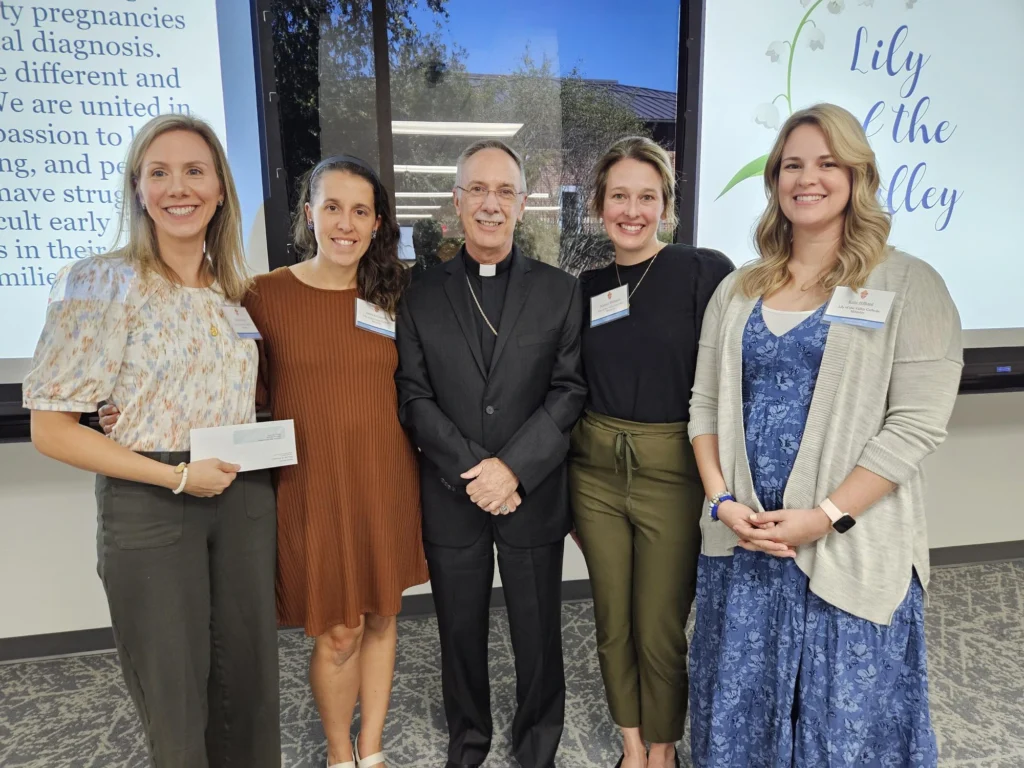
 As Co-Founder and Director of Mission for Lily of the Valley Catholic Ministry (LOTV), I want to share how your kindness and mercy has helped us grow from a small parish ministry into a nationwide source of prayer and comfort for families facing difficult early life circumstances. Read more to learn about our upcoming yearly retreat and how donor support has made an impact on changing the social script for families walking through infertility, prenatal diagnosis, postnatal medical challenges, and pregnancy or infant loss.
 Hi! I’m Katie. My journey with Lily of the Valley Ministry began through a special statue of the pregnant Virgin Mary. This statue had been a source of comfort during my own pregnancies. When I heard of Whitney walking with her son who had a difficult prenatal diagnosis, I felt called to pass the statue on to her. Several years later we reconnected and I learned the statue has been with LOTV since its inception and continues to be a symbol of hope and grace watching over this ministry, which now touches hundreds of families, all under Mary’s mantle. I gradually became more involved as a prayer ambassador and now as Content Designer.
 Hi, I’m Jamie-Lee Lavelle, a Catholic wife and mother. I have the incredible privilege of serving in my role as Prayer Care Package Support for Lily of the Valley, a ministry close to my heart that is dedicated to bringing God’s peace and healing to families experiencing profound grief and difficult early family life challenges.